![[The MIDI Pick™, v0.3]](images/the_midi_pick-v3-1-800x600.jpg "[The MIDI Pick™, v0.3]")
Introduction
In its traditional role, the guitar pick has been used to either strike or rake the strings of a guitar, bass or other stringed instrument. The pressure exerted on it has largely been ignored. The MIDI Pick™ embraces this behavior by translating finger pressure into numerical data that is streamed to the music programming language Max/MSP wirelessly. Max then sends that information to any other Max object that interprets numerical data, including MIDI objects.
How It Works
A force–sensing resistor, or FSR, is cast inside a specially-made guitar pick. The FSR itself is routed to a wrist-worn device that houses an 8-bit microcontroller, a battery, and a bluetooth module, among other components. The microcontroller continually reads the FSR and sends that information to the bluetooth module, which then transmits the FSR's information wirelessly to a bluetooth–enabled computer running Max/MSP.
Controlled by one of two onboard switches, The MIDI Pick™ operates in either of two modes: serial or switch. (The second switch is power.) In serial mode, The MIDI Pick™ transmits values between 0 and 127 (no pressure to heaviest pressure, respectively) wirelessly to the computer. In switch mode, The MIDI Pick™ acts as a toggle switch: when pressure exceeds a certain threshold, it sends a 1. When that threshold is exceeded again, it sends a 0, and so on.
Images
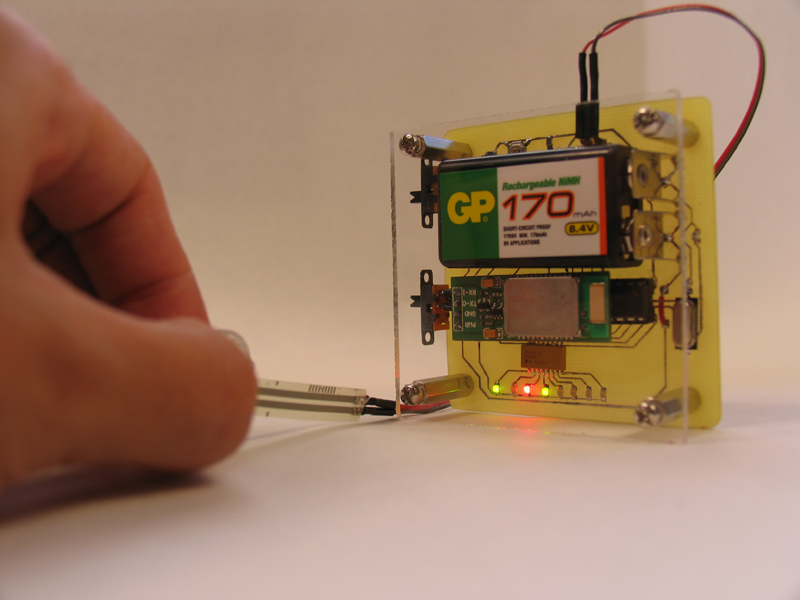

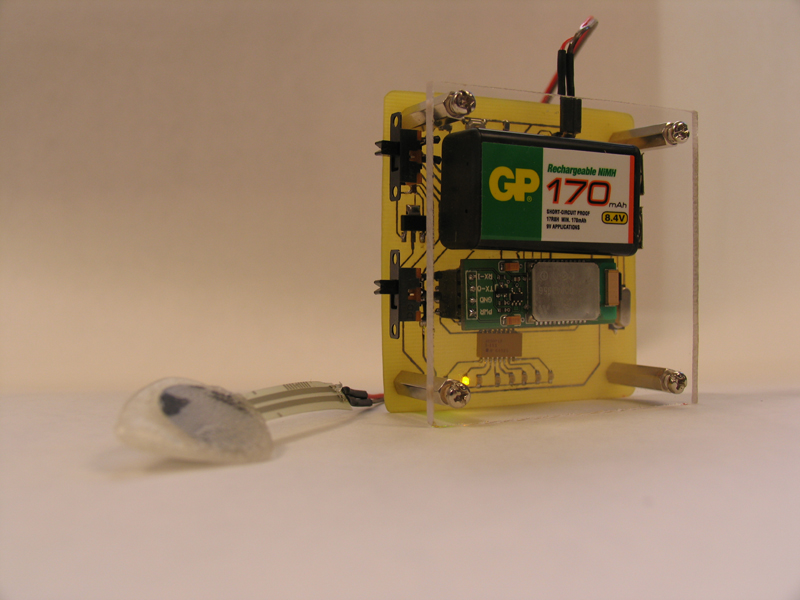
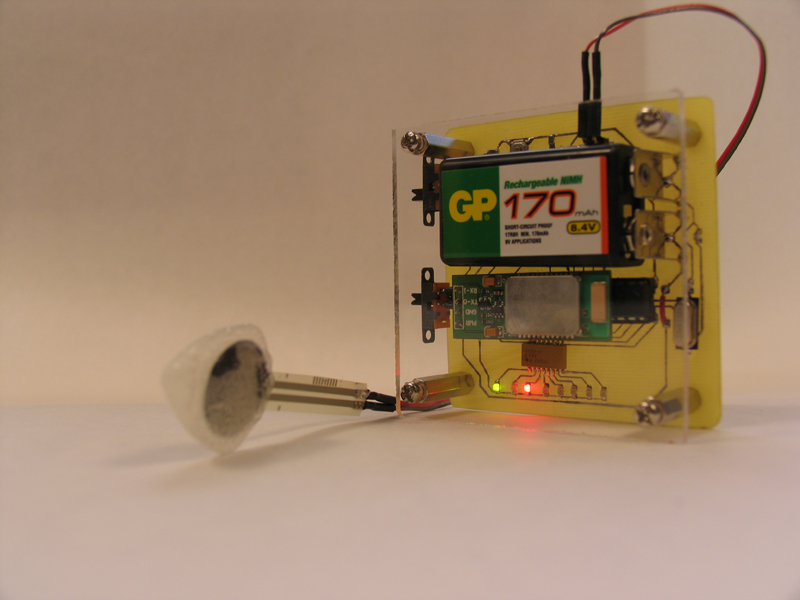
NIME Demo and Poster Presentation
On Friday, 8 June 2007, I demonstrated The MIDI Pick™ at the 2007 International Conference on New Instruments for Musical Expression. The demo and poster presentation took place during session 2 of the poster sessions.
Etsy Labs Demo
On Thursday, 15 November 2007, I presented The MIDI Pick™ for the last time in its next-to-final version at Etsy Labs (325 Gold St, Brooklyn, NY 11201). Current.com was on hand to document the event.
Read more about the event at Make magazine and Create Digital Music.
Paper
The published paper is available here as a scanned copy from the 2007 NIME proceedings, and my original submission — containing color images — is available here.
Code
- Arduino
TheMIDIPick.c(changed from .pde)setup_functions.hrun.hled_functions.hsend_functions.h
- Max volume patch
![[Screen dump of The MIDI Pick™ as a volume patch in Max]](images/the_midi_pick_as_a_volume_pedal.png)
Contact
Contact me by sending mail to the address listed in your browser's address bar— Roy Vanegas