Journal
January
During Younghyun's, Marc's and my visit to the Elizabeth Seton
Pediatric Center on 25 January 2007, Annette mentioned her
desire to change the hospital's look. She wanted the center to
look less like a hospital and more like a childrens' playground.
That idea struck a chord with Marc.
At our meeting on 29 January 2007, Marc suggested that we
design rooms and hallways in the pediatric center with specific
themes in mind (akin to a museum), where people can borrow a
listening device and hear someone's voice dictate a synopsis
about items in their presence. He suggested that we design
specific themes with framed pictures, then install them about
the hospital. A personal CD player would be used to provide
the audio.
Consider the following: imagine that one of the bedrooms in the
hospital has two framed, different–colored pictures
installed, and that a hallway nearby has two more installed. A
patient walks into the bedroom, say the Central Park room, puts
a CD in a portable player, puts on their headphones, and hits
track 1. They are greeted with
Welcome to Central Park, where you'll learn about colors. The
first painting on the left was painted in purple, which is made
by mixing red and blue. If you walk a few steps to the left,
you'll find an orange painting in a steel frame. Orange is
made by mixing yellow and red. We are done with this room.
Please hit pause, then proceed to the hallway, where the theme
is "shapes." Once there, please enter track 2 on
your portable player. Got it? Great! You may pause this CD
now.
A video
presentation of the idea described above.
February
No entries
March
- Week of 12 March
-
There's been a lot of consideration around finding the right
participant for the project. Ideally, the search is for
someone with enthusiasm for gaining an additional creative
tool, who would also benefit from whatever therapeutic
attributes of video are possible for the individual. Several
patients from Elizabeth Seton (either graduates or current
residents) have been considered. Ali, a
20–year–old male with very limited
fine–motor skills and high cognitive abilities was
collaboratively recruited with the help of OT's at Seton.
Marc spent a few hours with Ali and George McDermott (Ali's
OT) this week. Ali was more enthusiastic about the
possibilities of using video as the conversation went on,
but still exhibited some hesitation. Positive observations
from the visit include: Ali's skills navigating current
software and applications on his own computer via adapted
mouse controller and on-screen keyboard and, generally,
gaining a better understanding of Ali's personality and
motivators - a clearly creative, good-humored and talented
person.
Almost a week since our initial meeting Ali is still
hesitant (perhaps because he's wary of expectations), but
would like to move forward with a prototype.
We will move forward with all involved (OT's, designers,
etc.) aware of Ali's hesitation, but hopeful and confident
that his help in developing the prototype will lead to a
well–designed and adapted tool available for multiple
patients at Seton.
- Week of 26 March
-
We secured a camera that we'll use for the duration of the
project. We chose the camera based on 3 critical factors:
value, image quality, and format. For approximately $300.00,
we purchased a Canon ZR700 MiniDV cam w/remote. We struggled
with a few things:
-
Finding a camera in our price–range that came with a
remote (to hack)
-
Finding a camera in our price–range with image
quality (and a stabilization feature) that wouldn't
suffer too much from the bumping, etc. that will come as
a result of being attached to a motorized chair. And,
finally
-
finding a format that was affordable, offered limited
steps for "rendering" video, and where footage
didn't have to be "cycled out" frequently.
For all of these reasons, we ended up with MIniDv, which we
think will offer Ali long periods of shooting and an
affordable, high-quality image that doesn't require large
quantities of digital storage to preserve.
- Monday, 26 March
-
We had our second meeting with Ali. He had a chance to look
over the new camera and talk to us about his preferences for
how he'd like the camera to be mounted. Along with his OT,
George, and Annette, we took measurements and notes re.
constraints of Ali's chair. We also re–assessed Ali's
physical abilities/limitations and talked to him about the
ideals for setting up the physical properties of the camera
and controls. As a result, we're going to try and work with
Ali's limited left-hand mobility to devise a camera control
that will give him basic camera functions while he operates
his chair with his right hand. Adapting a control for his
right hand would limit his ability to shoot video and operate
the chair (move around) simultaneously. It seems the more
time we spend with Ali, the more excited he gets about having
access to the camera.
In the coming week, we're working on gathering materials for
the camera cradling device in order to build our April 5th
prototype. Simultaneously, Roy is taking a look at the
hack–ability of the Canon remote.
Once the project is finished, images and full
documentation will appear under the project link above.
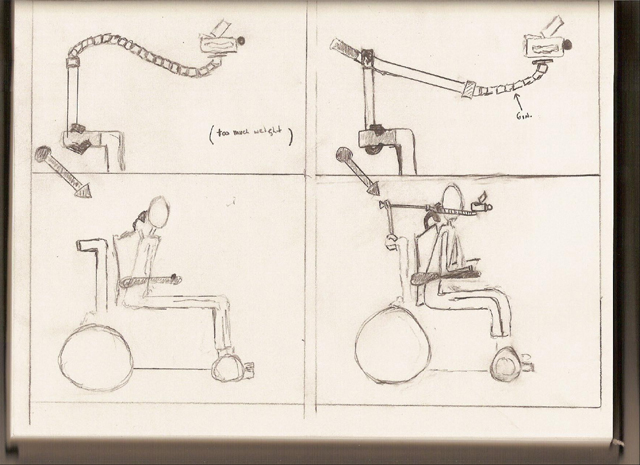
A sketch by Marc illustrates what the final project might
look like.
April
- Week of 2 April
-
We were able to assemble 90% of the camera cradle from
miscellaneous microphone stand components. Currently the
cradle consists of a typical boom system, with a vertical
and horizontal axis that can be adjusted for height and
positioning (and to store the camera out of the way when
traveling to/from a location). At the end of the 28in.
horizontal arm – this will come over Ali's shoulder to
position the camera – we've attached a 13in. gooseneck
that will offer more flexibility for camera positioning.
After testing, we felt this was the maximum amount of
gooseneck we could use in the overall design due to the
movement of the chair and weight of the camera in
combination. Any more gooseneck and the camera would be
jogging out of position too frequently. We're still working
on a c–clamp device that will secure the boom to the
back of Ali's chair, and a coupler that will mount the
camera to the gooseneck as seamlessly as possible.
The camera remote was opened and modified (see Image 1).
Roy used 0000 steel wool to sand down and expose the
contacts for the four main functions that Ali will use: Start
Record, Stop Record, Zoom In, and Zoom Out (see Image 2, and
note the white arrows at the top of the image). One end of
an 8–wire ribbon cable, two per control, was soldered
onto the exposed contacts of the remote, while the other end
was soldered onto an 8–row female header array (see
Image 3).

Image 1
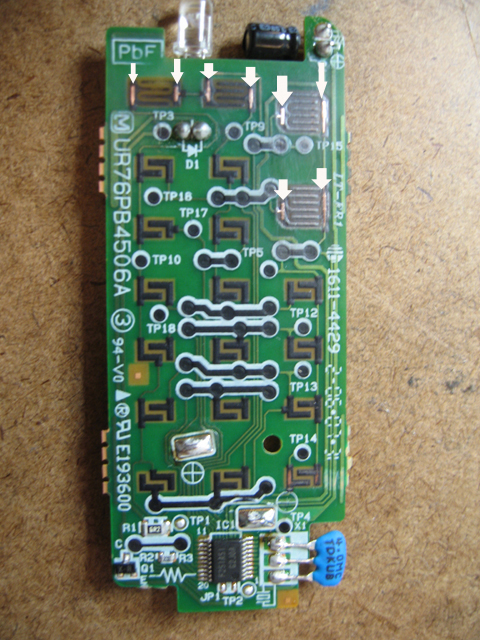
Image 2
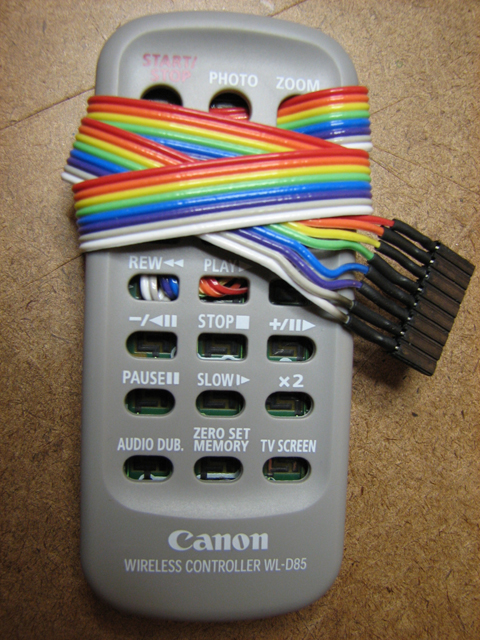
Image 3